
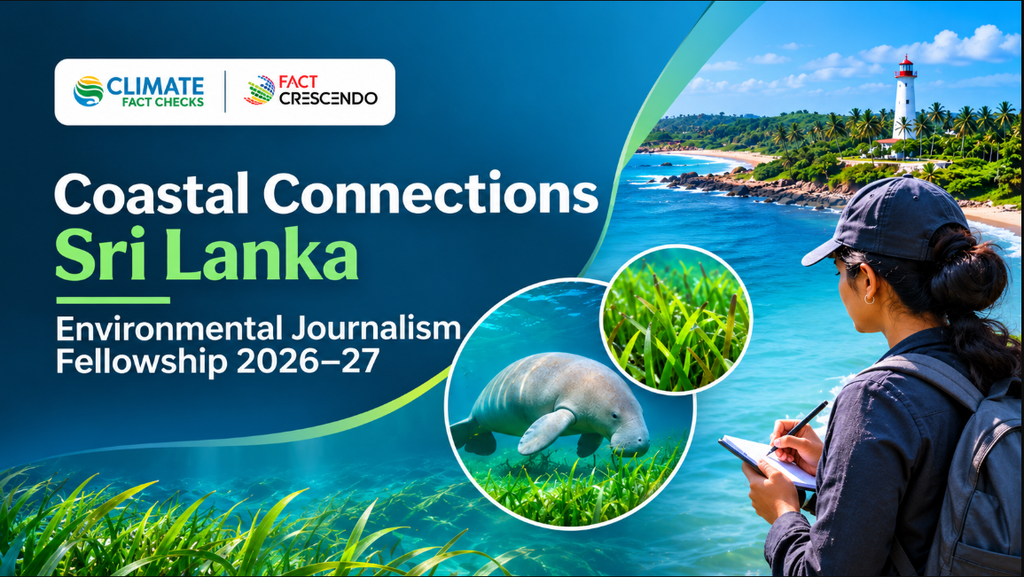
10 Young Journalists to Receive Fully Funded Environmental Journalism Fellowships in Sri Lanka
Ten young journalists and digital content creators will have the opportunity to participate in a fully funded environmental journalism fellowship aimed at strengthening reporting on Sri Lanka’s coastal ecosystems and marine conservation.
The Coastal Connections Sri Lanka Environmental Journalism Fellowship 2026–27, organised by Fact Crescendo Sri Lanka, will support young media professionals in investigating marine environmental issues, producing multimedia content and fact-checking claims related to ocean conservation.
The programme will run from December 2026 to August 2027, with a particular focus on coastal communities in Puttalam, Jaffna, Mannar and Batticaloa.
Applications: Coastal Connections Sri Lanka – Journalism Fellowship 2026–27
Training and field reporting opportunities
The selected participants will first attend an online training programme in December 2026. The sessions will cover marine ecosystems, seagrass conservation, blue carbon, environmental fact-checking and Sri Lanka’s commitment to protecting 30% of its ocean by 2030.
This will be followed by a residential workshop and field visit to the Puttalam–Kalpitiya coastal region in March 2027.
During the field programme, participants will visit seagrass habitats in Puttalam Lagoon, interact with marine scientists and engage with fishing communities to develop their reporting skills and story ideas.
All travel, accommodation, meals and field insurance costs associated with the residential workshop will be covered by the organisers.
Financial support for published stories
The fellowship will provide financial stipends for every story and video produced by participating journalists.
Selected fellows will also have opportunities to contribute to three short environmental documentaries, with additional payments available for those involved in documentary production.
Participants will receive individual editorial guidance, access to monthly online mentoring sessions and opportunities to publish their work in Sinhala, Tamil and English.
Eligibility requirements
The programme is open to journalists, freelance reporters, student journalists and content creators between 18 and 35 years of age.
Applicants can apply in Sinhala, Tamil or English. Previous experience in environmental journalism is not essential.
The organisers particularly encourage applications from women journalists and media professionals based in coastal areas, including Puttalam, Negombo, Jaffna, Mannar and Batticaloa.
There is no application or training fee.
Focus on protecting Sri Lanka’s marine environment
Sri Lanka launched its national 30×30 conservation programme in August 2024, targeting the protection of 30% of its land and ocean areas by 2030.
Marine ecosystems, including seagrass meadows, are important for carbon storage, fish breeding habitats and the survival of threatened marine species such as dugongs.
However, concerns remain over the management of marine protected areas, the conservation of seagrass habitats and the enforcement of regulations against bottom trawling.
Through this fellowship, participating journalists will investigate these issues and examine how marine conservation policies affect coastal communities and people whose livelihoods depend on the ocean.
The initiative is supported by Internews’ Earth Journalism Network through its 30×30 Media Grants.
How to apply
Applications: Coastal Connections Sri Lanka – Journalism Fellowship 2026–27
Applications must be submitted by November 15, 2026, at 11.59 p.m. Sri Lanka time.
Shortlisted candidates will be interviewed online between November 17 and 23, 2026.
Applicants are required to provide links to two or three examples of their previous work and a brief proposal for a story related to seagrass, marine conservation or coastal livelihoods.
Interested candidates can find further information and submit their applications through the official programme website:
