

Sri Lanka’s Green Transition: New Media Programme Aims to Strengthen Environmental Journalism
COLOMBO, Sri Lanka (LankaXpress) — The term “green transition” may still be unfamiliar to many Sri Lankans, but the changes it describes are already taking place across the country — from renewable energy and electric mobility to sustainable industries, climate finance, waste management and efforts to protect biodiversity.
A new media capacity-building programme supported by the European Union aims to help Sri Lankan journalists better understand these changes and explain their impact on the public.
The “Media Capacity Building Programme for the Promotion of the Green Transition” is being implemented by Expertise France, in partnership with Canal France International (CFI) and the Sri Lanka Press Institute (SLPI), with support from the EU-funded Green Recovery Facility.
The programme is designed to strengthen environmental journalism in Sri Lanka and help journalists produce more technical, investigative and data-driven reporting on climate change, climate finance, green investment, biodiversity, sustainable development and public policy.
Journalist Training on Green Transition Reporting
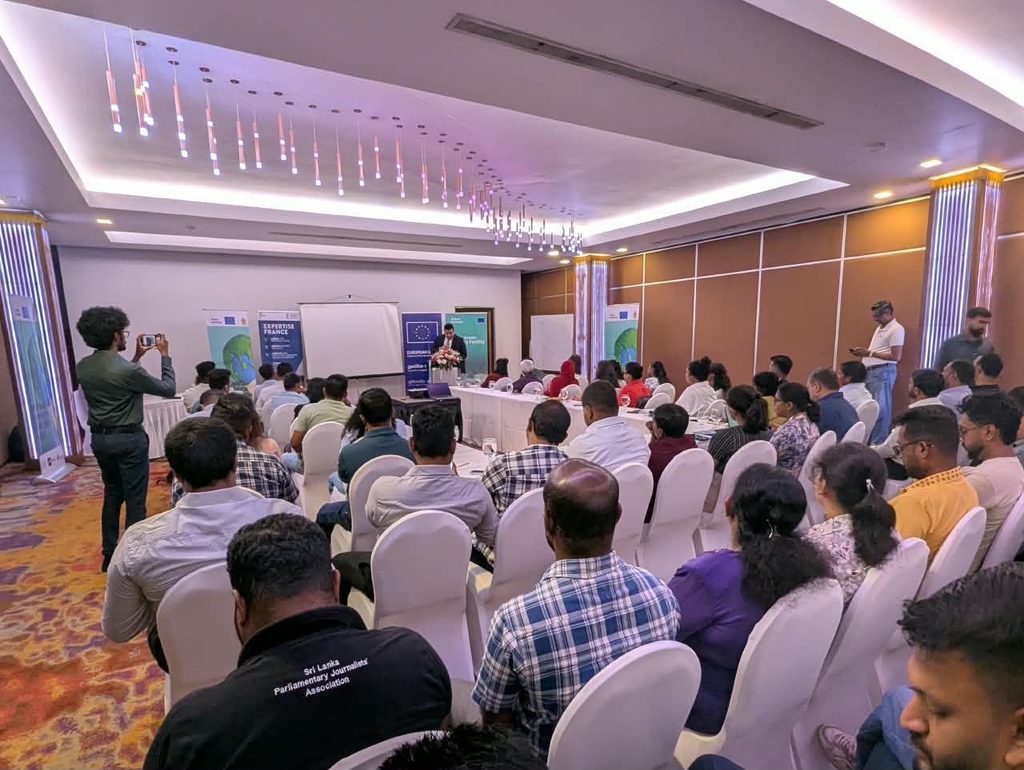
As part of this initiative, a two-day journalist training programme on Green Transition Reporting was held on October 3 and 4, 2026, bringing together journalists to strengthen their understanding and reporting skills on climate finance, green investment, environmental policy, biodiversity and sustainable development in Sri Lanka.
The training focused on helping journalists turn complex environmental and economic issues into clear, evidence-based and public-interest stories.
What does Sri Lanka’s green transition mean?
For many people, the words “green transition” can sound like a technical or international policy term.
In practical terms, however, it refers to the process of moving towards an economy that uses resources more efficiently, reduces pollution and greenhouse-gas emissions, expands cleaner sources of energy and supports more sustainable patterns of production and consumption.
In Sri Lanka, elements of this transition can already be seen in everyday life.
The country is expanding renewable energy, particularly solar and wind power, while looking at ways to reduce dependence on fossil fuels. Businesses are increasingly exploring energy efficiency and cleaner production. Electric vehicles and other forms of cleaner transport are gaining attention, while waste management, recycling, sustainable agriculture and biodiversity conservation are becoming increasingly important policy and economic issues.
At the same time, climate finance and green investment are becoming important as Sri Lanka seeks funding for projects that can support both economic recovery and environmental sustainability.
Yet, despite these developments, the broader concept of a “green transition” is not necessarily well understood by the general public.
This is where journalism can play an important role.
Turning technical issues into stories people can understand
The new programme seeks to help journalists connect complicated subjects such as climate finance, green investment and environmental policy with the everyday experiences of Sri Lankans.
For example, a journalist could examine how a renewable-energy project is financed, who benefits from the investment, how it affects electricity costs, what environmental impacts it may have and whether local communities are being adequately consulted.
Similarly, reporting on a green investment should go beyond announcing that a project has received funding.
Journalists can ask questions such as:
Where did the money come from? Who will receive it? What is the expected environmental benefit? Who is responsible for delivering the project? How will its impact be measured? And what happens if the promised results are not achieved?
These are the types of questions that can turn environmental reporting into deeper public-interest and investigative journalism.
From disaster reporting to deeper environmental journalism
Environmental reporting in Sri Lanka has traditionally focused heavily on floods, landslides, droughts, extreme weather and other natural disasters.
While such reporting remains essential, the organisers say there is an opportunity for Sri Lankan media to broaden environmental coverage.
The green transition programme encourages journalists to investigate the less visible economic, financial and policy dimensions of environmental issues.
That includes examining government policies, climate finance, green investments, sustainable industries, biodiversity, energy policy and the economic consequences of climate change.
The objective is not simply to produce more environmental stories, but to produce journalism that helps the public understand why these issues matter and how they affect people’s lives.
Why climate finance matters to Sri Lanka
Climate finance is another area that can appear highly technical to the public.
In reality, it can have a direct connection to Sri Lanka’s development.
Countries such as Sri Lanka require significant investment to adapt to climate change, improve resilience, develop renewable energy, modernise infrastructure and reduce emissions.
Understanding where this money comes from — whether through international institutions, governments, development partners, private investment or other mechanisms — and how it is spent is therefore an important area for journalists to investigate.
The programme aims to give journalists the skills needed to follow this money and assess whether investments are delivering the environmental and social outcomes promised.
The “just transition” and communities
The programme also places emphasis on the concept of a “just transition.”
A green economy should not only focus on reducing emissions or increasing renewable energy. The transition also needs to consider the people and communities affected by economic and environmental changes.
For Sri Lanka, this can raise important questions about jobs, livelihoods, energy affordability, rural communities, workers, women and vulnerable populations.
The programme therefore encourages journalists to bring the voices of women and vulnerable groups into national discussions about environmental policy and sustainable development.
60 journalists to receive foundation training
The initiative is designed to provide trilingual foundation training for 60 journalists working in Sinhala, Tamil and English media.
The programme aims to reach journalists across all nine provinces of Sri Lanka, helping create a wider network of media professionals capable of reporting on green-transition issues.
The first phase of the foundation training has now taken place, providing participating journalists with an introduction to the key concepts and reporting approaches required to investigate environmental and green-transition issues.
Six Story Labs to develop investigative reports
The programme will go beyond classroom training.
It includes six intensive Story Labs, where journalists will receive direct editorial mentoring to develop, investigate and publish high-quality stories related to the green transition.
Selected journalists will also have opportunities for field reporting support and story development, allowing them to take ideas from training sessions into real-world reporting.
This approach is intended to ensure that the programme produces not only trained journalists but also actual public-interest journalism that can inform Sri Lankan audiences.
Why this matters for Sri Lankan journalism
Sri Lanka’s green transition will affect many areas of the economy and society.
It could influence how electricity is generated, how businesses operate, how cities manage waste, how people travel, how agriculture responds to climate change and how the country attracts investment.
But if these developments are discussed only through technical policy documents and economic reports, much of the public may not understand their significance.
Journalists have an important role in translating these complicated subjects into clear, evidence-based stories that ordinary people can understand.
The new programme therefore seeks to strengthen the media’s ability to ask not only “What is happening?”, but also “Who benefits, who pays, what are the environmental consequences and what does this mean for Sri Lankan citizens?”
A green transition already underway
For many Sri Lankans, “green transition” may be a new phrase — but the transition itself is not entirely new.
Renewable-energy projects, sustainable production initiatives, climate-resilient infrastructure, electric mobility, conservation efforts, waste-management programmes and green investment are already forming parts of the country’s changing economic landscape.
The challenge is making these developments understandable, measurable and accountable.
The EU-supported media programme aims to help Sri Lankan journalists do exactly that — giving them the knowledge, investigative tools and editorial support needed to examine Sri Lanka’s green transition through a public-interest lens.
Ultimately, the programme seeks to strengthen the role of Sri Lankan media in helping citizens understand how environmental and economic policies are shaping the country’s future.
LankaXpress.com
